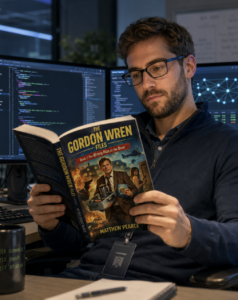
IT consultants rarely arrive at a client’s office expecting espionage. They arrive expecting passwords written on sticky notes, undocumented software, cables leading nowhere, and a server that everyone insists was working perfectly yesterday. Their job begins where the obvious explanations end.
That is exactly why The Gordon Wren Files: Book 1: The Wrong Man at the Door feels tailor-made for technology consultants.
Gordon Wren is not a secret agent, a military operative, or an international man of mystery. He is a middle-aged kitchen-appliance salesman who has spent years walking through expensive homes, hotel corridors, loading areas, trade events, and badly organized product demonstrations. When he becomes caught in a conspiracy unfolding around an international summit, the trained professionals assume his powers of observation must come from classified experience.
They are wrong.
Gordon simply recognizes when people, equipment, deliveries, and procedures do not fit together. That practical awareness makes The Wrong Man at the Door one of the best spy thriller books for IT consultants who have built careers by noticing the small problem everyone else overlooked. 🖥️
IT Consultants Understand the Value of Noticing What Is Out of Place
The field of information technology consulting is commonly associated with software, networks, cybersecurity, data management, and digital strategy. Beneath all those specialties, however, sits one essential skill: pattern recognition.
An experienced consultant walks into an unfamiliar business and begins collecting details. A workstation is connecting through the wrong access point. A shared account has more permissions than it needs. A cloud service appears on an invoice, but nobody remembers approving it. A supposedly random outage happens at the same time every afternoon.
Each clue may appear harmless by itself. Together, they reveal a pattern.
Gordon approaches danger in much the same way. He notices incorrect packaging, impractical delivery routes, suspicious service traffic, and people handling ordinary objects with unusual care. He does not identify these details because he received intelligence training. He notices them because he understands how real work gets done.
The distinction matters. Plenty of fictional heroes survive through extraordinary combat skills or sophisticated surveillance equipment. Gordon survives by understanding logistics, workplace behavior, and the quiet signs of incompetence. His talent is familiar to anyone who has ever fixed a network problem after five people confidently declared that the network was fine.
The Story Treats Troubleshooting Like a Survival Skill
A good IT consultant knows that the first explanation is often incomplete.
A user reports that the printer is broken. The printer is working, but the computer is sending documents to a device in another department. A company blames its internet provider for slow performance. The real cause is an automated backup consuming bandwidth during business hours. A manager believes an employee deleted important files. The files were moved by a synchronization rule nobody remembered creating.
Troubleshooting requires patience, skepticism, and a willingness to inspect the entire environment.
According to CIO’s overview of the IT consultant profession, consultants help organizations design, develop, and execute technology projects in support of business goals. That responsibility extends far beyond installing software. Consultants must understand how systems, people, budgets, workflows, and operational priorities interact.
Gordon operates within a similarly tangled environment. The suspicious activity surrounding him is hidden inside normal commercial movement. Catering supplies, conference inventory, domestic equipment, service entrances, and hotel operations become pieces of a much larger puzzle. He cannot isolate one clue and declare the case solved. He must understand how everything moves through the building.
That approach gives the novel a satisfying sense of logic. Gordon’s discoveries do not feel like magical deductions pulled from thin air. They grow from the same practical reasoning that experienced consultants use when tracing a problem across several connected systems.
Gordon Wren Is the Accidental Hero Every Consultant Recognizes
IT consultants are often called after a problem has already confused everyone else.
The internal team tried restarting the system. The vendor denied responsibility. Management scheduled three meetings. Someone created a spreadsheet to document the failure. By the time the consultant arrives, the problem has acquired a history, a political dimension, and several competing explanations.
The consultant then finds an expired certificate, an incorrect configuration, or a forgotten dependency.
Gordon’s experience is a more dangerous version of that familiar situation. The professionals surrounding him repeatedly misinterpret ordinary competence as secret expertise. His ability to remain useful under pressure convinces intelligence officers and criminals that he must possess advanced training.
Gordon finds this assumption deeply irritating.
That irritation is one of the novel’s greatest strengths. He is not chasing glory or trying to cultivate a mysterious reputation. He wants people to stop mishandling expensive equipment, disrupting sensible procedures, and making avoidable mistakes. His frustration creates humor without weakening the suspense.
The comedy works especially well for consultants because it reflects a familiar workplace truth: competence often looks miraculous in an environment where nobody has checked the basics.
The Novel Understands That Systems Include People
Technology problems are rarely limited to technology.
The U.S. Bureau of Labor Statistics description of computer systems analysts explains that these professionals study an organization’s existing systems and procedures before designing improvements. Their work includes consulting with managers, comparing technologies, evaluating costs and benefits, and helping business leaders understand how technology supports operations.
The word “procedures” is important. A perfectly configured platform can still fail when employees misunderstand it, ignore it, or invent unofficial workarounds. A secure system becomes vulnerable when someone shares a password. A reliable process collapses when responsibilities are unclear. A carefully planned deployment falls apart because one department never received the instructions.
Gordon reads human behavior as carefully as an IT consultant reads a system log. He notices when a route makes no practical sense. He recognizes when someone carries an ordinary item as though it contains something valuable. He understands that people reveal priorities through movement, hesitation, and misplaced attention.
His observations give the thriller a grounded form of intelligence. The danger is not hidden behind endless technical jargon or impossible gadgets. It is hidden inside ordinary behavior.
That makes every hotel hallway, delivery cart, demonstration area, and service entrance feel potentially significant. ⚙️
Cybersecurity Professionals Will Recognize the Importance of Small Anomalies
Modern cybersecurity depends heavily on identifying behavior that differs from an established baseline.
A login from an unusual location, an unexpected transfer of data, a newly created administrative account, or a device communicating at an uncommon time may signal a larger incident. None of these events automatically proves malicious activity, but each deserves attention within the broader context.
The NIST Cybersecurity Framework emphasizes understanding, assessing, prioritizing, and communicating cybersecurity risk. Its core functions include governance, identification, protection, detection, response, and recovery. Those functions reflect a disciplined approach to discovering problems before they grow into disasters.
Gordon’s instincts operate along similar lines. He establishes an internal picture of what normal commercial activity should look like. When packaging, routes, equipment, or personnel violate that picture, he pays attention.
He may not describe what he is doing as anomaly detection, but that is essentially the result.
This is one reason the story feels rewarding rather than convenient. Gordon succeeds because he has spent years absorbing operational details that other people dismiss as unimportant. His background becomes useful in a setting nobody could have predicted.
For consultants, that idea carries real weight. The tedious project, difficult client, confusing migration, or chaotic deployment may teach lessons that become invaluable later. Experience builds quietly, often through situations that feel unremarkable at the time.
The Suspense Reflects the Logic Behind Zero Trust
Traditional security once relied heavily on the idea that activity inside a protected environment could be trusted. Modern systems are more complicated. Employees work remotely, applications operate across several cloud platforms, vendors receive limited access, and data moves between devices, locations, and services.
The Cybersecurity and Infrastructure Security Agency’s Zero Trust Maturity Model supports a security approach in which access and activity are continually evaluated rather than automatically trusted because of location or prior approval.
That mindset fits the world of The Wrong Man at the Door. Gordon does not assume that an object is harmless because it arrived through a service entrance. He does not assume that a person belongs in an area because they appear comfortable. He does not assume that a delivery is legitimate because the paperwork looks professional.
He examines whether the details make sense.
The novel turns this habit into suspense. Readers begin evaluating every ordinary object and routine interaction alongside Gordon. A cart becomes more than a cart. A corridor becomes more than a path between rooms. A box becomes evidence that something inside the operation is wrong.
For an IT consultant, this constant evaluation feels natural. Trust must be supported by context.
It Captures the Chaos of Managing Several Problems at Once
Real consulting work rarely presents one clean issue at a time.
A migration may involve outdated hardware, licensing problems, nervous employees, poor documentation, vendor delays, security concerns, budget restrictions, and a deadline established by someone who never reviewed the technical requirements.
Consultants must separate urgent problems from distracting ones while keeping the entire project moving.
IBM’s technology consulting overview highlights the connection between cloud systems, artificial intelligence, automation, efficiency, customer experience, and broader business strategy. Modern consultants often work across several disciplines because technology decisions affect nearly every part of an organization.
Gordon faces his own rapidly expanding collection of interconnected problems. A suspicious house leads into compromised hotel operations. Criminal logistics hide within ordinary service activity. Intelligence officers misread his identity. Dangerous people interpret his improvisation as deliberate strategy.
Each development adds pressure without abandoning the central premise. Gordon remains the same observant, irritated salesman even as the scale of the danger grows.
That consistency makes the escalating absurdity work. The world becomes increasingly chaotic, but the hero continues approaching it through practical concerns. He studies the process, identifies the failure, and tries to prevent careless people from making everything worse.
The Humor Feels Familiar to Anyone Who Has Worked in Technical Support
Spy thrillers often depend on polished confidence. Characters deliver precise instructions, use flawless equipment, and execute complicated plans with perfect timing.
IT consultants know another reality.
The conference room display refuses to detect the laptop. The executive cannot remember the password created ten minutes earlier. The critical software update begins during the presentation. The temporary workaround from three years ago has quietly become the company’s permanent infrastructure.
The Wrong Man at the Door finds humor in the gap between how professionals imagine a situation and how the situation actually works.
Gordon’s frustration with incompetence gives the novel its comic rhythm. He is surrounded by people who believe they are participating in a sophisticated intelligence operation. Gordon keeps noticing the logistical mistakes, impractical decisions, and mishandled equipment underneath the drama.
Anyone who follows sources such as the Microsoft Security Blog understands that modern technology professionals operate in a world of evolving threats, complex systems, and continuous defensive work. Even the most advanced strategy can be undermined by a basic oversight.
The novel takes that reality and pushes it into the territory of international espionage. The result is funny because the underlying frustration is recognizable.
Gordon Represents a Different Kind of Intelligence
Gordon is not valuable because he knows classified codes or advanced combat tactics. He is valuable because he pays attention to practical reality.
He understands what equipment should look like, how deliveries should move, and how people behave when they are doing legitimate work. His intelligence has been built through repetition, observation, and years of being underestimated.
IT consultants often develop the same kind of knowledge. They may not remember every command, specification, or configuration setting without checking documentation. They do remember the warning signs. They recognize the pause before a user admits something important. They know when a proposed timeline ignores reality. They notice when a vendor’s explanation avoids the central issue.
This form of intelligence rarely appears dramatic until a crisis occurs.
The novel respects it. Gordon’s ordinary professional experience is not discarded when the adventure begins. It becomes the reason he can navigate the adventure at all.
That is a refreshing departure from stories in which an average character suddenly becomes an entirely different person. Gordon does not transform into a conventional action hero. The conspiracy is forced to deal with Gordon as he already is.
The Book Delivers Espionage Without Losing Its Human Scale
Large international conspiracies can sometimes make characters feel secondary to the plot. Secret organizations, political stakes, and elaborate schemes take over while the hero becomes a vehicle for action scenes.
The Wrong Man at the Door keeps its focus on Gordon.
The larger operation matters, but the reader remains connected to one irritated man trying to understand why everyone around him is behaving so foolishly. His perspective keeps the tension accessible. It also gives the story a distinctive personality.
The novel offers intelligence officers, criminals, compromised locations, suspicious logistics, sharp dialogue, and mounting danger. It balances those ingredients with a hero whose greatest advantage is an unwillingness to ignore obvious nonsense.
For IT consultants accustomed to solving problems inside environments filled with competing agendas, incomplete information, and confident mistakes, Gordon’s experience feels strangely relatable. The consequences are larger, but the process is familiar.
Observe the environment. Verify assumptions. Follow the anomaly. Protect the important equipment. Try to prevent disaster. 🔍
Conclusion
The Gordon Wren Files: Book 1: The Wrong Man at the Door gives IT consultants a spy hero they can understand.
Gordon Wren does not dominate the story through physical power, expensive technology, or secret training. He succeeds because he notices when the pieces of a system do not belong together. He understands ordinary operations well enough to recognize extraordinary interference.
That ability lies at the center of good consulting.
The most valuable consultant is often the person who sees the relationship between a minor technical symptom, a flawed process, and a larger business risk. Gordon applies the same discipline to suspicious deliveries, compromised spaces, criminal logistics, and an international conspiracy.
The result is a fast, funny thriller built around competence, observation, and practical reasoning. It celebrates the people who inspect the details everyone else walks past.
For IT consultants who spend their days solving mysteries hidden inside systems, workflows, and human behavior, Gordon Wren may be the most relatable accidental spy they have encountered.